
Rupture, Layered Amnesia, and the Reassembly of the Knower
By Rich Fegley
Independent preprint · Version 1.0 · July 2026
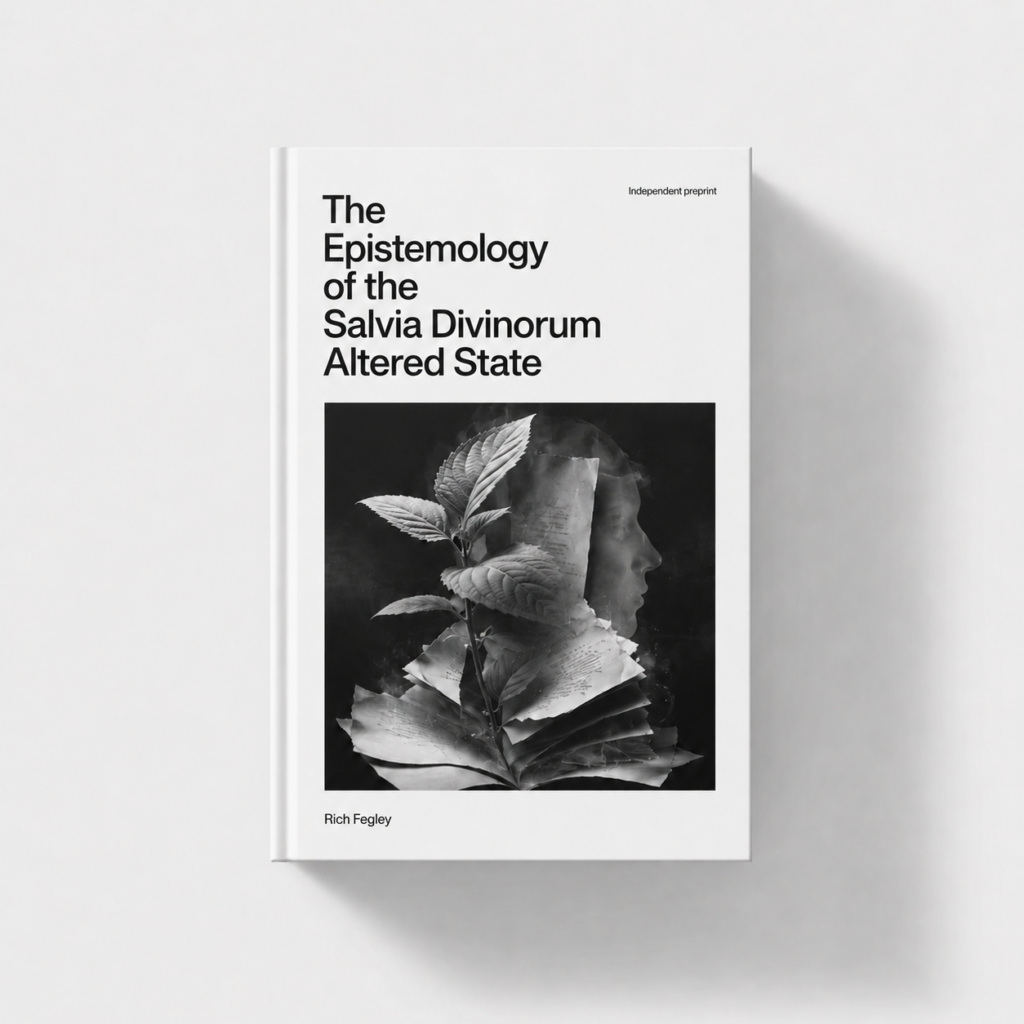
The Epistemology of the Salvia Divinorum Altered State
Rupture, Layered Amnesia, and the Reassembly of the Knower
By Rich Fegley
A 120-page interdisciplinary inquiry into what the Salvia divinorum rupture can reveal about knowledge, memory, altered-state phenomenology, and the reconstruction of the ordinary self.
Read the Work
Begin with the six-page précis for a concise statement of the question, thesis, evidence, and limits—or read the complete 120-page preprint.
Free to read · Independent preprint · Not peer reviewed
The manuscript’s central claim is that the Salvia rupture is epistemologically significant less for the recognition “I have been here before” than for what its brevity and structural compression make observable: the stepwise reassembly of the ordinary knower on return.
About the manuscript
The Epistemology of the Salvia Divinorum Altered State examines what kind of knowledge, if any, can be drawn from one of the most disruptive and difficult-to-remember altered states.
Its central argument is that Salvia’s epistemic value may lie less in the familiar recognition—I have been here before—than in the unusually visible process by which the ordinary self, memory, and world are reconstructed during the return. Drawing on first-person accounts, clinical research, specialist phenomenologies, and a wider corpus of reports, the manuscript maps the rupture while testing it against Tibetan bardo theory, Jungian psychology, Gnostic and Shaivite traditions, Gurdjieff, Analytic Idealism, and deflationary self-model theories.
The work does not claim to prove a metaphysical interpretation. It offers a rigorous provisional map of the experience, its evidentiary limits, and what it may reveal about the construction of the knower.
Phenomenology
Layered amnesia, recognition, encountered presences, the aware void, and the stepwise return through which memory, identity, and ordinary world-orientation are reassembled.
Interpretive Frameworks
Tibetan bardo theory, Jungian depth psychology, Gnostic and Shaivite traditions, Gurdjieff’s fragmented-I, Analytic Idealism, and Metzinger’s deflationary self-model account.
Epistemic Discipline
Claims are distinguished as phenomenologically real, structurally real, veridical under a named framework, or metaphysically established. The manuscript explicitly declines the final status.
Frequently Asked Questions
Is this a peer-reviewed academic paper?
No. This is an independently researched, long-form preprint. It draws on clinical research, published phenomenologies, first-person accounts, philosophy of mind, and comparative contemplative traditions, but it has not undergone formal academic peer review.
How long is the manuscript, and where should I begin?
The full manuscript is approximately 60,000 words and contains seven parts, an Argument Overview, glossary, references, and endnotes. Readers seeking a shorter introduction should begin with the précis, which presents the argument, evidence, and limitations before entering the full work.
Does the manuscript claim that Salvia proves universal consciousness?
No. The author writes from the standpoint of Analytic Idealism, but the manuscript does not treat that framework as proven by the experience. Idealist, deflationary, and agnostic interpretations are held in tension. Its strongest claim concerns the observable structure of the rupture—particularly layered amnesia and the stepwise reassembly of the ordinary self—not a final metaphysical conclusion.
How was artificial intelligence used?
Claude and ChatGPT were used in an editorial and analytic capacity, including reference checking, consistency auditing, structural review, and pressure-testing arguments. AI output is not treated as evidence, source, or authority. The phenomenological record, source selection, interpretations, conclusions, and final responsibility for the manuscript remain the author’s.